
Field Dispatch: The Temple That Was Tuned
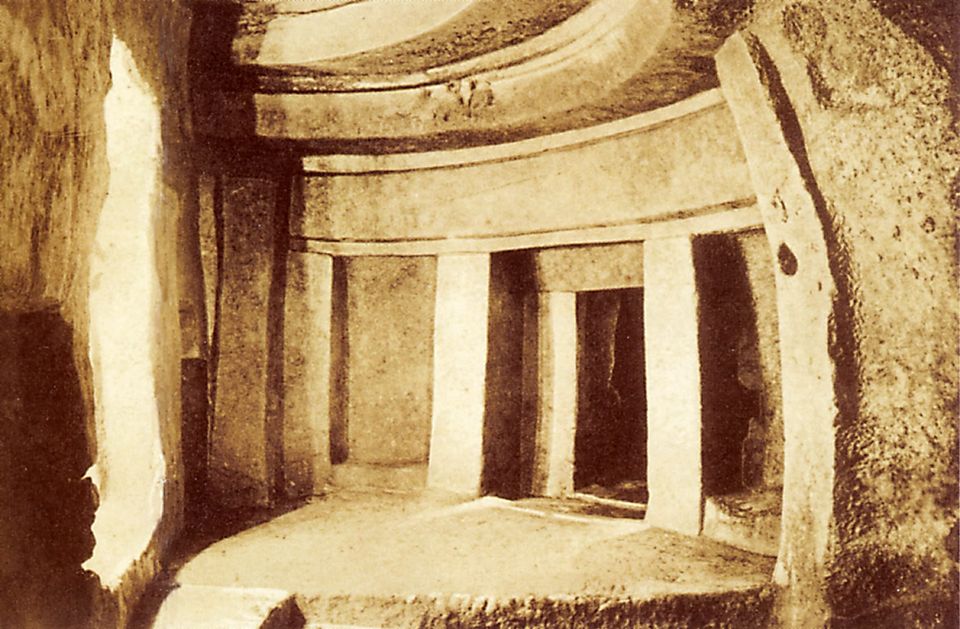
In 1902, workers in the town of Paola, Malta, broke through a ceiling they didn’t know was there. Below them was a three-level underground complex carved from Globigerina limestone with stone and bone tools, sometime between 3600 and 2500 BCE. The Hypogeum of Ħal Saflieni. It held the remains of roughly seven thousand people. The architecture on the lower levels mirrors the megalithic temples on Malta’s surface, but inverted — carved downward into the rock rather than built upward from it. Columns, lintels, corbelled ceilings, all sculpted in negative. The builders weren’t constructing a building. They were uncovering one that was already inside the stone.
On the middle level there’s a small room called the Oracle Room. It has two niches carved into the wall, and the larger one is shaped like a mouth.
For decades, visitors reported strange effects in this chamber. A low voice spoken into the niche seemed to fill the entire underground complex. The sound didn’t behave the way sound should. You felt it in your sternum and your teeth before you heard it with your ears. Tour guides mentioned it. Archaeologists noted it. Nobody actually measured it.
Then, starting around 2014, people finally brought instruments.
-----
A team led by Paolo Debertolis of the University of Trieste ran systematic acoustic measurements and published their results in the *Journal of Anthropology and Archaeology* in 2015. In the Oracle Room they found a strong double resonance at 70 Hz and 114 Hz — both within range of a deep male voice. When a baritone hit those frequencies, the resonance propagated through the entire complex. Percussion instruments could trigger it through harmonics. During testing, sounds echoed for up to thirteen seconds.
Interesting. But possibly just a lucky accident of the chamber’s shape.
It wasn’t.
In 2020, Kristina Wolfe, Douglas Swanson, and Rupert Till published a paper in the *Journal of Archaeological Science: Reports* that made the accident theory much harder to sustain. They took the first comprehensive frequency measurements of the middle level, then ran the data through a 3D simulation of the wave equation using nothing but the site’s geometry. The observed frequencies dropped out of the model — but only because the wall dimensions across multiple chambers that aren’t even connected to each other had been fine-tuned to produce those specific peaks. The paper’s language is careful. “Unlikely to be coincidental” is what they wrote.
And the detail that won’t let me go: the peak frequencies are evenly spaced. They map onto something that resembles a whole-tone scale.
Five thousand years ago, people with bone tools carved a musical instrument out of the inside of a limestone hill.
-----
Now here’s the part that made me sit down.
In 2008, Ian Cook and colleagues at the UCLA Laboratory of Brain, Behavior, and Pharmacology published a study in *Time and Mind*. They monitored brain activity in thirty volunteers via EEG while exposing them to tones at various frequencies — including frequencies matching those found at the Hypogeum and similar Neolithic chambers across Europe.
At 110 Hz, the EEG data did something the researchers hadn’t anticipated. Activity over the prefrontal cortex shifted abruptly. The language center — the part of the brain that narrates your experience, that runs the verbal commentary track of conscious thought — went quiet. At the same time, activity shifted from left-hemisphere dominance to right-hemisphere dominance. Right hemisphere: emotional processing, spatial awareness, pattern recognition.
I want to say that again more plainly. The frequency this underground temple is tuned to produce is the frequency that turns off the part of your brain that talks to you.
Subsequent work at the University of Trieste, using EEG monitoring in a Faraday-shielded chamber, confirmed and extended the UCLA results. Each volunteer showed peak sensitivity at a slightly different personal frequency within the 90–120 Hz window — but the window itself was consistent across subjects.
And the same frequency range has been measured at Neolithic sites across Europe. Newgrange passage tomb in Ireland. Cairns in England and Scotland. Stone chambers in Italy. Different cultures, different centuries, different latitudes. Same resonance window. Same effect on the brain.
-----
The standard explanation for all of this is that the Hypogeum’s builders noticed the interesting sound effects and incorporated them into ritual practice. Fine. Probably true, as far as it goes. Iegor Reznikoff, an emeritus professor of music anthropology who has spent years studying acoustics at Paleolithic painted caves across France, positions the Hypogeum as a surviving link in a chain running from cave paintings to Romanesque chapels — tens of thousands of years of humans seeking out resonant spaces for ritual.
But the Wolfe paper makes “noticed and incorporated” feel insufficient. Fine-tuning wall dimensions across rooms that aren’t even adjacent to each other implies something more active than noticing. It implies testing and iterating. Carving a wall section, checking the acoustic result, adjusting. Coordinating the geometries of separate chambers to produce a unified frequency profile across the complex.
That’s engineering. Performed without writing, without metal, without anything we’d consider adequate tooling. And it produced results that modern acoustic modeling, with computers and spectrum analyzers, confirms are real, measurable, and reproducible.
They understood something about the relationship between stone geometry and low-frequency sound that we didn’t rediscover until we had the equipment to measure it. They couldn’t have written a paper about it. They didn’t need to. They carved it into the hill and let the limestone do the talking.
-----
The Hypogeum sits on Globigerina limestone. The geology isn’t incidental to the acoustics — it’s the medium. Limestone density and porosity determine how sound propagates through it. The formation matters. The substrate matters.
That’s the question running through everything I’m writing in *The Places That Speak*: why do the oldest sacred sites on earth keep showing up on the same kinds of geological formations? Fault lines. Aquifer discharge points. Limestone karst with acoustic anomalies. Volcanic substrates with measurable gas emissions. Not similar geology. The same geology. Across cultures that had no contact with each other, separated by thousands of years and thousands of miles.
The Hypogeum doesn’t answer that question. But it’s the first data point — a culture with bone tools that carved an acoustic instrument into a specific limestone formation, producing resonance that measurably alters how the human brain works. They did it five thousand years ago. They did it on purpose. And the geology is the reason it works.
Every claim in this dispatch is published, peer-reviewed, and Googleable. I’ve listed the sources below. None of this is fringe. It’s just not widely known, because acousticians and neuroscientists and archaeologists and geologists don’t tend to read each other’s journals.
I read a ton of them. That’s what this project is for.
A 5,000-year-old temple carved into limestone by people with no metal tools resonates at 110 Hz — the exact frequency where the human brain downshifts out of language processing. Malta is where Marcus's investigation begins in The Places That Speak, and where the question stops being academic. The dispatches are always free to read. If you want to know when the next one goes up and get The Map — where you can explore Malta's geology alongside every other site in the investigation — sign up. Free, ten seconds, no spam.
Sources
Debertolis, P., Coimbra, F., & Eneix, L. (2015). “Archaeoacoustic Analysis of the Ħal Saflieni Hypogeum in Malta.” *Journal of Anthropology and Archaeology*, 3(1), 59–79.
Wolfe, K., Swanson, D., & Till, R. (2020). “The frequency spectrum and geometry of the Ħal Saflieni Hypogeum appear tuned.” *Journal of Archaeological Science: Reports*, 34, 102623.
Cook, I.A., Pajot, S.K., & Leuchter, A.F. (2008). “Ancient Architectural Acoustic Resonance Patterns and Regional Brain Activity.” *Time and Mind*, 1(1), 95–104.
Till, R. (2017). “An archaeoacoustic study of the Ħal Saflieni Hypogeum on Malta.” *Antiquity*, 91(355), 74–89.


