Field Dispatch: The Valley That Glows - Forty Years of Science in Hessdalen, Norway
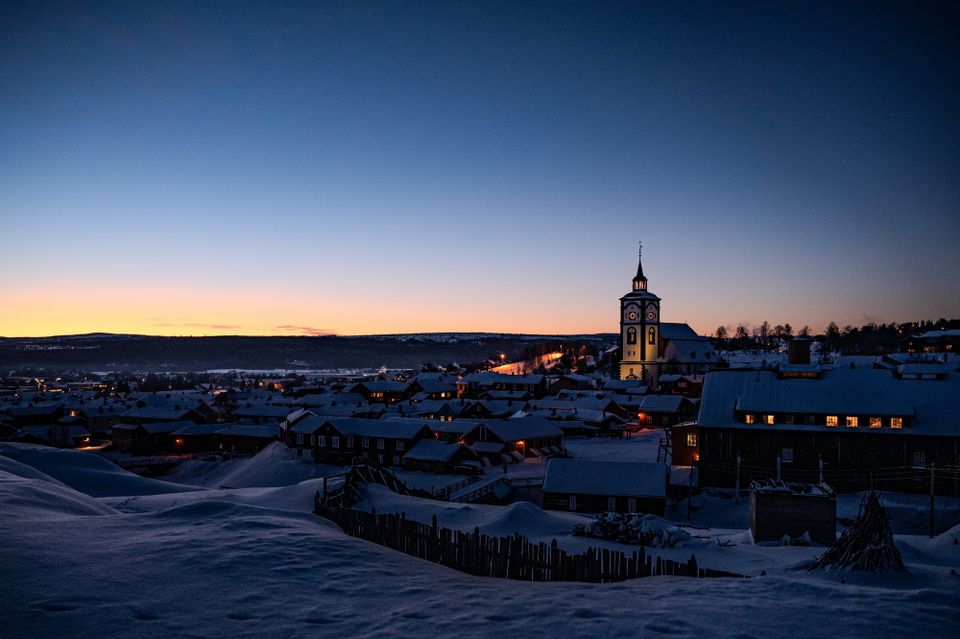
There's a valley in central Norway where the geology does something nobody can fully explain.
Hessdalen is a fifteen-kilometer trough running north to south between two mountain ranges, about 120 kilometers south of Trondheim. Around 150 people live there. The valley sits at roughly 600 meters altitude, and in winter the temperature drops below minus thirty. In the south, at 800 metres, a lake called Øyungen feeds the river Hesja, which runs north through the centre of the valley. There are abandoned copper mines. There are ancient bog iron workings that date back two thousand years. And in the southern part of the valley sits one of Norway's largest undeveloped ore deposits — several hundred tons of copper and zinc, still in the ground.
The other thing the valley produces, roughly ten to twenty times a year, is light.
Not reflected light, not refracted light. Light that appears in the air above the valley floor and does things that light is not supposed to do. Balls of it, mostly — white, yellow, red, sometimes blue — ranging from the size of a distant star to the size of a car. They hover. They drift. They change color. They sometimes split into smaller lights that move independently, then recombine. They have been clocked on instruments at speeds exceeding 30,000 kilometers per hour. They can last for a few seconds or for more than an hour. And they show up on radar even when they're invisible to the naked eye, producing a strong infrared signature that persists after the visible light fades.
They have been reported in this valley since at least the 1930s, and possibly since 1811. And since 1983, they have been the subject of continuous, instrumented scientific investigation. As of 2026, no single explanation has been confirmed.
How the Science Started
In late 1981, the sightings spiked. Residents were reporting lights fifteen to twenty times per week. The local population was small enough that dismissing the reports as mass hysteria required ignoring people who had lived in the valley for decades and knew what the night sky was supposed to look like. By 1983, the Norwegian organizations UFO-Norge and UFO-Sverige had initiated Project Hessdalen — not because they were convinced the lights were alien spacecraft, but because the phenomenon was repeatable, localized, and therefore testable.
The first field investigation ran during the winter of 1984. A team of engineers, students, and volunteers deployed cameras, radar, magnetometers, and radiometric equipment across the valley. In an eighteen-day field session, they recorded 53 sightings. Erling Strand, an electronics and telecommunications engineer who would become the project's lead researcher, documented the lights with both visual and instrumental evidence: they reflected radar, they produced anomalous readings on magnetometers, and they were not aircraft, satellites, or known atmospheric phenomena.
That first campaign was funded on a shoestring and staffed by volunteers. But the data was clean enough to attract professional interest. In 1994, the first international scientific conference on the Hessdalen phenomenon brought together 27 scientists from eight countries. By 1998, Østfold University College had installed the Hessdalen Automatic Measurement Station — a research container called the "Blue Box," equipped with cameras, spectrometers, radar, and sensors that run continuously, capturing data around the clock regardless of whether anyone is physically present.
The Blue Box is still running. It has been recording for over twenty-five years.
What the Instruments Have Captured
The lights are not misidentified aircraft or headlights or satellites. Multiple instruments have recorded the same event simultaneously from different positions, confirming that the lights are physical objects with measurable properties. They produce radar returns even when they're not visible in the optical spectrum. Night vision equipment operating in the 700–1000 nanometer range has picked up strong infrared signatures from phenomena that were invisible or barely visible to the eye. Whatever is generating this light isn't always doing it in wavelengths humans can see.
Spectral analysis — principally by Italian astrophysicist Massimo Teodorani during the EMBLA research program, a joint Norwegian-Italian collaboration between Østfold University College and the Italian Institute of Radioastronomy in Bologna, active from 2000 to 2002 — estimated the temperature of the lights at approximately 5,000 Kelvin. The spectral profile, nearly flat on top with steep sides, is characteristic of an optically thick thermal plasma. Not reflected sunlight. Not combustion. Not bioluminescence. Ionised gas.
And there's one more property that nobody has adequately explained: the lights sometimes produce short, pulsating bursts in the VLF and HF radio bands, occasionally showing Doppler characteristics. During the original 1984 campaign, researchers directed a laser beam at one of the lights and reported that its pulsation frequency changed in apparent response.
A Battery the Size of a Valley
Forget the lights for a moment and look at the ground.
The valley's western slopes are rich in zinc and iron-bearing minerals. The eastern slopes contain copper. Running between them, the river Hesja receives a continuous input of sulphuric acid from abandoned mine workings in the valley floor. Two thousand years of mining — bog iron, copper, zinc — have left the valley's hydrology laced with dissolved metals and acid drainage.
In 2014, Italian radio astronomer Jader Monari, from the Institute of Radio Astronomy in Medicina, proposed a hypothesis that made international news when New Scientist picked it up. His argument: the valley is functioning as a natural electrochemical cell. A geological battery.
The zinc-and-iron-rich rocks on one side act as one electrode. The copper-rich rocks on the other side act as the second electrode. The river Hesja, acidified by mine drainage, acts as the electrolyte. When rain fills the old mine shafts, sulphuric acid leaches into the river, creating a conducting medium between the two dissimilar metal deposits.
Monari and his colleague Romano Serra at the University of Bologna tested it. They took rock samples from opposite sides of the valley, set them up as electrodes, and submerged them in river sediment. Current flowed. Enough to light a lamp.
His proposal is that this battery produces bubbles of ionized gas when sulphurous fumes from the river react with humid air. The gas bubbles become electrically charged by the battery's field, and the field's electromagnetic lines guide the charged gas through the valley. The discharge produces visible light.
The Trouble with the Battery
Norwegian physicist Bjørn H. Samset, quoted extensively in Science Norway's coverage, was blunt. The distance between the "electrodes" is kilometers, not centimeters. You can make a battery with two rocks and some mud on a lab bench — whether an electrochemical process scales to a valley floor at sufficient current density to ionize gas is an entirely different proposition. Samset called the whole thing "inadequately substantiated" and said New Scientist shouldn't have published the piece.
There's also a temperature problem. If the lights are plasma at 5,000 Kelvin, they should scorch anything they touch. They don't appear to leave burn marks on vegetation or the ground. Researchers have reported that they seem to sterilize soil at contact points — an absence of microbes where lights have been reported to land — but not thermal damage. Sterilization without scorching. That doesn't fit the battery model, and it doesn't fit any of the other models particularly well either.
And the battery isn't the only idea on the table.
Brazilian physicists Gerson Paiva and Carlton Taft, publishing in the Journal of Atmospheric and Solar-Terrestrial Physics (2010) and Meteorology and Atmospheric Physics (2012), proposed a dusty plasma model. In their framework, radon gas seeping from the valley's bedrock decays, releasing alpha particles that ionize atmospheric dust. The resulting dusty plasma — a mixture of ionized gas and charged dust grains — could form Coulomb crystals: ordered geometric structures within the plasma. This actually accounts for something the battery model can't touch: at low luminosity, the Hessdalen lights sometimes show rectangular and geometric shapes, documented in both video and conventional photography. Dusty plasma theory, well established in space physics, predicts exactly this kind of self-organising structure. A battery discharge doesn't.
Others have pointed to piezoelectricity — the phenomenon whereby quartz-bearing rocks under mechanical stress produce electrical charges. The valley contains abundant quartz. If tectonic stress is periodically compressing quartz deposits, the resulting electrical discharge could ionize the air above. This mechanism has been proposed for earthquake lights worldwide, and a 2014 paper in Seismological Research Letters by Friedemann Freund and colleagues documented a plausible mechanism for how stressed rock can release charge carriers that travel to the surface and ionize the atmosphere.
Nobody knows which of these is right. It might be one. It might be all three working together. It might be something nobody has proposed yet.
Hessdalen Isn't Alone
Similar phenomena have been reported at Brown Mountain in North Carolina, the Marfa area in Texas, the Yakima region in Washington State, the Longdendale Valley in England, and the Australian outback where the Min Min lights are observed. Earthquake lights — luminous phenomena tied to seismic activity — have been reported for centuries and were scientifically validated with photographs during the 1965 Nagano earthquake sequence in Japan. The common features across all of these reports: geologically active locations, luminous phenomena near ground level, and an association with faulting, mineralization, or underground water systems.
What makes Hessdalen different is that someone built a research station and left it running for a quarter of a century.
The 2024 VLF electromagnetic survey of the valley, conducted by French, Norwegian, and Italian researchers and published in the Journal of Applied Geophysics, mapped conductive structures across 100 square kilometers of the valley floor. They found that the conductive zones — associated with sulphide mineral deposits — trace an elliptical pattern roughly 6 by 12 kilometers, aligned with a large gabbro intrusion in the bedrock. The researchers concluded that these near-surface geological structures could supply the conditions needed to generate the lights, and recommended similar surveys at other locations where analogous phenomena are observed.
The geology is specific. Light phenomena don't happen everywhere — they happen at places with particular combinations of mineralogy, hydrology, faulting, and atmospheric conditions. The question at this point isn't really whether geology can produce anomalous light. It can. The question is the mechanism, and why these particular spots and not others.
Still Running
Project Hessdalen is in its forty-third year. It runs on volunteers. The automated station records daily. The data is publicly available. Researchers from Norway, Italy, France, and beyond continue to publish.
The sightings persist at roughly ten to thirty events per year, with some correlation to the solar cycle — geomagnetic disturbance appears to modulate the frequency, though the relationship isn't fully characterized.
The valley is accessible. About two to three hours by car from Trondheim. No admission fee. You can drive up there, stand in the cold, and wait. Some nights, something lights up above the valley floor that four decades of science hasn't been able to explain. It's been happening since before anyone was measuring it, and it hasn't stopped since they started.
Nobody's solved the Hessdalen lights in forty-three years of continuous measurement. The valley shares geological signatures with three of the sites Marcus visits in The Places That Speak — including one where the instruments picked up something the battery model can't touch. The dispatches are always free. But if you want to know when the next one drops and get The Map — an interactive guide to every site in the investigation and the geology that connects them — sign up. It's free and takes ten seconds.
Key References:
Teodorani, M. (2004). "A Long-Term Scientific Survey of the Hessdalen Phenomenon." Journal of Scientific Exploration, Vol. 18, No. 2, pp. 217–251. Paiva
G.S. & Taft, C.A. (2010). "A hypothetical dusty-plasma mechanism of Hessdalen lights." Journal of Atmospheric and Solar-Terrestrial Physics, Vol. 72, pp. 1200–1203. Paiva
G.S. & Taft, C.A. (2012). "A mechanism to explain the spectrum of the Hessdalen lights." Meteorology and Atmospheric Physics, Vol. 117, pp. 1–4
VLF electromagnetic survey (2024), Journal of Applied Geophysics. Project Hessdalen data and archives: hessdalen.org