Field Dispatch: The Romans Built the Gates of Hell on a Super Volcano. Half a Million People Still Live There.
You've probably never heard of Campi Flegrei. That's the problem.
If I said "supervolcano," most people would picture Yellowstone. The caldera under Wyoming, the magma chamber big enough to bury half the continental United States in ash, the eruption that's "overdue" depending on which geologist you ask and how many drinks they've had.
But there's another one. It's in Italy. It's under a city. And unlike Yellowstone, it's not sitting quietly.
Campi Flegrei — the "Burning Fields" — is a volcanic caldera roughly twelve to fifteen kilometers across, sitting directly beneath the western suburbs of Naples and the adjacent city of Pozzuoli. About half a million people live within the designated red evacuation zone. Another million and a half live close enough that a major eruption would ruin their week, their year, and possibly their century.
And over the past two decades, it's been doing something that the scientific community considers worth watching very carefully.
The ground is breathing
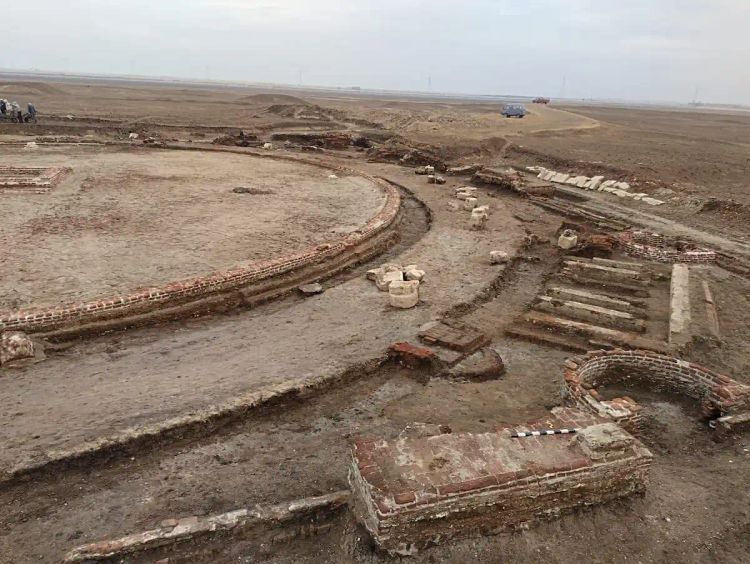
The technical term is bradyseism — slow vertical movement of the earth's surface, driven by magmatic and hydrothermal activity below. Campi Flegrei has been doing this for millennia. The Romans noticed it. The columns of the ancient Macellum market in Pozzuoli — sometimes incorrectly called the Temple of Serapis — show bands of marine boreholes halfway up the shafts, evidence that the ground sank below sea level and then rose again, repeatedly, over centuries. The sea literally moved through the building and left its marks.
But here's what's different now.
Since 2005, the ground beneath Campi Flegrei has been rising continuously. By late 2024, that uplift had exceeded 1.4 meters at Pozzuoli's Rione Terra neighbourhood — the point of maximum deformation. That's nearly five feet. In geological terms, this is not slow. The uplift has been accompanied by more than nine thousand earthquakes over the past decade, most of them small, some of them decidedly not small. On September 27, 2023, a magnitude 4.2 earthquake struck — the strongest recorded in the area in forty years. In May 2024, a 4.4 followed, breaking that record again within months. Schools were temporarily closed. Cracks appeared in buildings. Italy's civil protection agency issued updated emergency planning documents. The local population, already anxious, became significantly more so.
The caldera is not erupting. But the ground is rising, the earthquakes are getting stronger, and the monitoring stations are recording changes that haven't been seen since the last major crisis in the 1980s.
Why nobody talks about this
There's a strange paradox with Campi Flegrei. It is one of the most intensively monitored volcanic systems on Earth. Italy's Osservatorio Vesuviano maintains an extensive sensor network across the caldera — seismometers, GPS stations, gas monitoring equipment, tiltmeters. The data is publicly available. The science appears in peer-reviewed journals. Nothing about this is secret.
And yet most people outside Italy have never heard of it.
Part of the reason is Vesuvius — the volcano that buried Pompeii — which sits directly across the Bay of Naples and absorbs all the cultural oxygen. Vesuvius is the famous one, the postcard volcano, the one that appears in every documentary about Roman catastrophe. Campi Flegrei, by contrast, doesn't look like a volcano. There's no cone. No peak. It's a landscape — a wide, shallow depression filled with neighbourhoods and apartment blocks and pizzerias and schools. If you walked through Pozzuoli without knowing what you were standing on, you'd think it was a pleasant, slightly run-down coastal Italian town.
That's part of what makes it unsettling. The caldera is invisible until you know what to look for. And then you can't unsee it.
The ancient record
The Romans weren't confused about what Campi Flegrei was. They called it the entrance to the underworld.
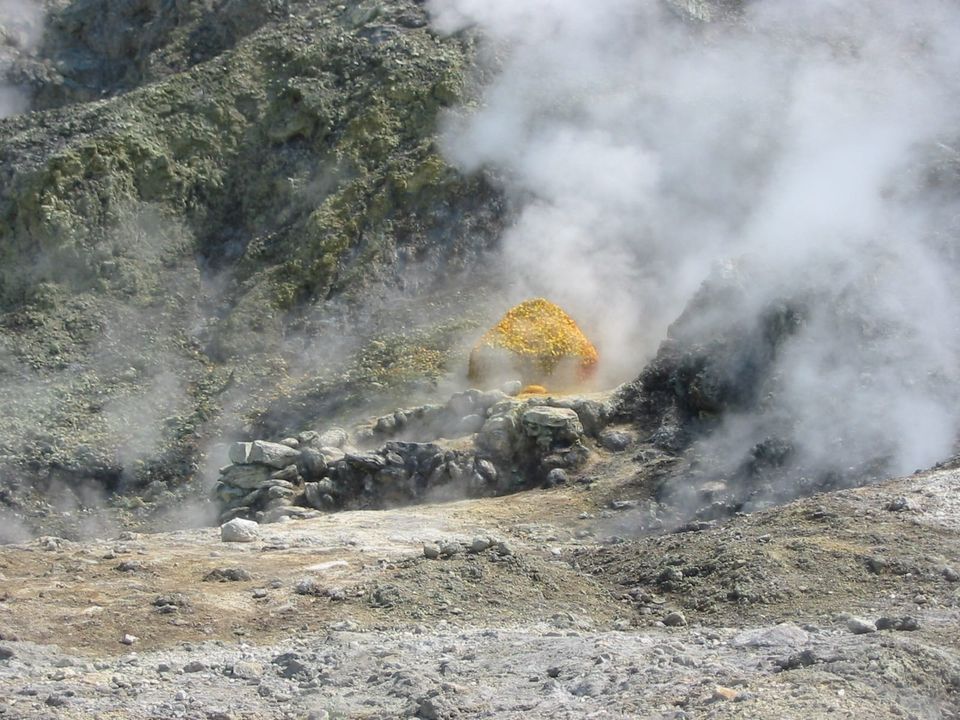
The Cumaean Sibyl — one of the most important oracular figures in the ancient Mediterranean — operated from a site at Cumae, on the western edge of the caldera. A trapezoidal tunnel carved into the volcanic tuff there has been traditionally identified as her prophetic chamber, though some archaeologists argue it served a military purpose. Regardless, Virgil set Aeneas's descent into the underworld here, in Book VI of the Aeneid, and the physical landscape he describes — the sulphurous fumes, the dead lake, the groaning ground — is not poetic license. It's reportage. Cumae sits on an active volcanic system, and the gases that seep through the rock are real. Lake Avernus, the legendary entrance to Hades, is a volcanic crater lake that ancient writers claimed could kill birds flying too low over its surface — most likely a carbon dioxide accumulation effect, the same phenomenon that killed 1,746 people at Lake Nyos in Cameroon in 1986, when pressurised CO₂ erupted from the lake bed and rolled silently through sleeping villages.
The Sibyl prophesied on a volcanic caldera, and the ancients treated the entire landscape as sacred and dangerous. Temples were built. Rituals were maintained. The oracular tradition at Cumae endured for centuries — from roughly the eighth century BCE through to the displacement of pagan practice in late antiquity.
Then the rituals stopped. The temples were abandoned or converted. The sacred sites fell into disuse.
And the volcano kept doing what volcanoes do.
What's actually happening underground
The current scientific understanding is this: a large body of magma sits approximately eight kilometres beneath the caldera. Above it, a shallower hydrothermal system — superheated water and gas trapped between three and four kilometres down — interacts with the rock and drives surface movement. The uplift is caused by some combination of magmatic activity at depth and hydrothermal pressurisation closer to the surface, as expanding gases push upward through fractured rock. The precise balance between these two mechanisms is still actively debated among researchers.
The critical question — and the one nobody can yet answer definitively — is whether the current unrest will lead to an eruption, and if so, what kind.
Campi Flegrei's geological record contains two major eruptions. The first, approximately 39,000 years ago, was the largest explosive volcanic event in Europe in at least 200,000 years — the Campanian Ignimbrite eruption, which ejected somewhere between 200 and 300 cubic kilometres of material and may have contributed to the regional collapse of Neanderthal populations, though scientists continue to debate the degree of its influence. The second recorded eruption, in 1538, produced Monte Nuovo — a new hill that rose entirely from flat ground over about a week, killing a small number of people who stayed too close. By the standards of the first event, it was a footnote.
The worry isn't that the next eruption will necessarily be another Campanian Ignimbrite. The worry is that even a Monte Nuovo-scale event inside a densely populated urban area would be catastrophic. Italy's civil protection authorities maintain an evacuation plan for the red zone — roughly half a million people — that assumes approximately 72 hours of warning. The honest answer from the scientific community is that 72 hours might be optimistic. Or it might be generous. Nobody knows.
That uncertainty is the thing. Campi Flegrei isn't dangerous because scientists understand it poorly. It's dangerous because they understand it well enough to know how many variables remain unresolved.
The thing nobody wants to say
Here's the uncomfortable thought that sits underneath all the monitoring data and the evacuation plans and the published papers.
For centuries, the people who lived on this caldera treated it as a living system that required active attention. The Sibyl's rituals, the temple protocols, the sacred prohibitions — whatever you think about the metaphysics, these were sustained, multigenerational practices specifically designed for this landscape. They were maintained continuously for longer than most modern nations have existed.
Those practices stopped.
The geological system didn't.
I'm not suggesting that ancient rituals were literally suppressing volcanic activity. But I am suggesting that the question of why ancient civilisations consistently chose to build their most important sacred sites on geologically active features — and what they thought they were accomplishing there — is more interesting than we've been willing to admit.
Campi Flegrei isn't just a hazard management problem. It's a question about what we've forgotten. And whether forgetting it has consequences.
Half a million people live on top of a supervolcano that most of them have never heard of, in the same place the Romans decided to build an entrance to the underworld. Campi Flegrei sits on the same volcanic substrate as two of the sixteen sites Marcus investigates in The Places That Speak. That's not a coincidence — it's the pattern. The dispatches are always free to read. If you want to know when the next one goes up and get The Map — where you can explore every site and the formations they share — sign up. Costs nothing.
Get The Map →
Sources and further reading
Chiodini, G. et al. "Magmas near the critical degassing pressure drive volcanic unrest towards a critical state." Nature Communications 7 (2016).
Kilburn, C.R.J. et al. "Progressive approach to eruption at Campi Flegrei caldera in southern Italy." Nature Communications 8 (2017).
De Natale, G. et al. "Weighing the risk at Campi Flegrei." Nature (October 2023).
Sessa, E.B. et al. "Ground uplift and seismic activity at Campi Flegrei caldera." Bollettino di Geofisica Teorica e Applicata (2024).
Costa, A. et al. "Reconstructing the Campanian Ignimbrite eruption." Nature (2012).
Kling, G.W. et al. "The 1986 Lake Nyos gas disaster in Cameroon, West Africa." Science 236 (1987).
Osservatorio Vesuviano / Ongoing surveillance bulletins at: ingv.it