
Field Dispatch: The Lurker at the Threshold - A 3,000-Year-Old Field Guide to Dangerous Geography
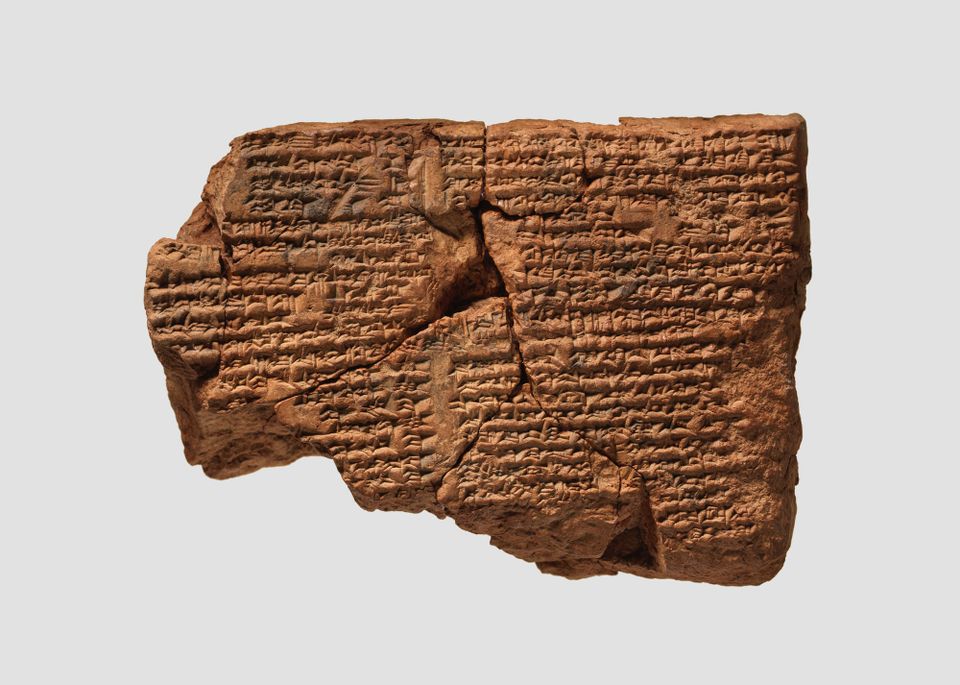
How a 3,000-year-old Mesopotamian demon manual accidentally mapped the geography of the sacred.
Three thousand years ago, somewhere in what is now southern Iraq, a scribe pressed a reed stylus into wet clay and began cataloging demons.
Not metaphorical demons. Not moral failings dressed in supernatural clothing. Actual entities, named and classified, each assigned to a specific type of landscape the way a modern ecologist assigns species to habitats. Threshold demons. Ruin demons. Desert demons. Marsh demons. Subterranean water demons. Every one mapped to a geographic feature with the precision of a field taxonomy.
The series is called the Utukku Lemnūtu, Akkadian for “Evil Demons.” It survives as sixteen cuneiform tablets, compiled around 1000 BCE from much older Sumerian originals, some of which trace back to the third millennium BCE. The definitive modern critical edition was published by Assyriologist Markham Geller, first in 2007 and expanded in 2016. Several original tablets sit in the Metropolitan Museum of Art in New York, including copies of Tablets 3, 12, and 16, acquired in 1886. You can go see them. They’re about the size of your palm, and they contain the oldest systematic classification of non-human entities by geographic habitat that survives in written form.
Most people who encounter the Utukku Lemnūtu at all encounter it as a curiosity, an artifact of ancient superstition, interesting the way a medieval bestiary is interesting. Quaint. Irrational. Safely historical.
I think that reading is incomplete. And the evidence for why is more concrete than you’d expect.
What the Tablets Actually Say
The conventional framing of Mesopotamian demonology is that it’s religious literature. And it is. The Utukku Lemnūtu tablets were part of the professional library of the āšipu, the exorcist-healer, one of the most prominent scholarly roles in Mesopotamian society. The incantations they contain were therapeutic tools, used in treating patients whose illnesses were attributed to demonic interference. Tablet 3 focuses on protecting the āšipu himself when he goes to visit a patient. The exorcist needed shielding before he could shield anyone else. Tablet 12 describes a scapegoat ritual in which a goat absorbs a patient’s affliction and is driven into the wilderness, carrying the contamination back to the terrain where it originated.
But here’s what gets overlooked when we file these texts under “religion” and move on: the demon taxonomy in the Utukku Lemnūtu is organized geographically. Not morally. Not hierarchically. Geographically.
Every class of entity in the Mesopotamian demonological corpus is assigned to a specific type of landscape feature:
The rabisu, from the Akkadian rabāṣu, “to crouch” or “to lie in wait”, inhabits thresholds and doorways. It’s a creature of architectural transitions, the space where inside becomes outside. The name itself tells you what it does: it crouches. It waits. At the boundary.
The Mesopotamian response was specific and physical. For royal palaces, enormous apotropaic figures, the lamassu and shedu, winged bulls and human-headed lions, some over sixteen feet tall and weighing up to forty tons, were positioned in pairs flanking every major doorway. Over a hundred of these have been identified at Neo-Assyrian palace sites. But for ordinary houses, the practice was different and arguably more revealing: lamassu were engraved on clay tablets and buried directly under the door’s threshold. The countermeasure was deployed into the boundary itself. Additionally, inscribed terra-cotta incantation bowls, sometimes called “devil’s traps”, were placed in the four corners of building foundations, their texts written in spirals from rim to center, designed to capture and contain the rabisu at the point of entry.
This isn’t vague spiritual anxiety. It’s targeted intervention at a specific architectural feature, repeated systematically across both monumental and domestic architecture for centuries.
The rabisu is so deeply embedded in ancient Near Eastern consciousness that it appears to have migrated into the Hebrew Bible. In Genesis 4:7, sin is described as rōbēṣ, “crouching at the door.” The Hebrew word is a direct cognate of the Akkadian rabāṣu. Assyriologist E.A. Speiser was among the first to formally identify this connection in his Anchor Bible commentary on Genesis. The lurker at the threshold, it turns out, is one of the oldest continuous ideas in recorded human thought.
The alû, “the destroyer”, inhabits ruins and abandoned places. Where human habitation fails, the alû moves in. It’s faceless. Formless. Described in Neo-Assyrian exorcistic tablets without mouth, ears, or recognizable features. An entity of desolation that occupies the niche left by departed humans. Geographic succession: the spiritual equivalent of weeds reclaiming a parking lot.
The lilû and lilītu, ancestors of the later Lilith tradition, inhabit desert wind, open wasteland, the spaces between settlements. They are creatures of exposure, associated with night, wind, and the vast emptiness between the places humans have claimed and named.
The utukku themselves, the category that gives the series its name, are associated with mountains, deserts, marshes, and the sea. The wild, undomesticated geography. The Sumerian udug was an ambiguous category, capable of both good and ill, and scholar Graham Cunningham has argued that “daimon” is a more accurate translation than “demon.” No visual representations of the utukku have been positively identified. They are described with features common to Mesopotamian demons: a dark shadow, an absence of light, poison, and a deafening voice.
And beneath all of them, in the cosmological basement: the Abzû, the freshwater deep. Not a demon but a realm. A geographic substrate that is simultaneously a physical phenomenon (the water table pressing upward through Mesopotamian alluvium), a deity’s domain (Enki/Ea’s seat of power), and a cosmological concept (the primordial freshwater ocean beneath the earth). At Eridu, the oldest temple site in Mesopotamia, you can crouch at the base of the ancient mound and put your hand on the soil. It’s measurably cooler than the surrounding earth. The water table is pressing upward. The Sumerians didn’t have to imagine the Abzû. It was breathing on their ankles.
The Pattern, And the Honest Objection
Map those habitat assignments: threshold, ruin, desert, wilderness, marsh, subterranean water. Every single one is a liminal zone, a boundary where one condition transitions into another. Doorway: inside becomes outside. Ruin: habitation becomes abandonment. Desert: settlement becomes wilderness. Marsh: land becomes water. Subterranean deep: surface becomes subsurface.
The demons live at transitions.
And this isn’t unique to Mesopotamia. Hecate stands at crossroads in Greek tradition. Papa Legba guards the gate in Vodou. Jizō marks the path between worlds in Japanese Buddhism. The pattern repeats across cultures that had no contact with each other, separated by thousands of miles and thousands of years.
Now, the honest objection, the one I’d raise myself: Of course they put monsters at boundaries. Transitional places are inherently scary. You’re leaving the known for the unknown. The psychological projection explanation is elegant and sufficient. We fear liminal spaces, so we populate them with threatening entities. End of story.
That’s a reasonable position. It’s the standard academic one. And I held it for a long time.
Here’s what moved me off it.
The Locations Are Measurably Different
If the psychological projection theory is complete, we fear transitions, so we populate them with monsters, the ritual responses should address the fear. You’d expect prayers before crossing a doorway, calming rituals in the room beyond, reassurance directed at the person experiencing the anxiety. And those exist in the Mesopotamian corpus, certainly.
But they aren’t the primary response. The primary response is something else entirely: physical interventions embedded into the boundary infrastructure itself.
For palaces, they carved forty-ton winged bulls and positioned them at doorways, not in the throne room, not in the bedroom where the king actually slept. For ordinary houses, they engraved lamassu on clay tablets and buried them directly under the door’s threshold. They placed inscribed incantation bowls in the four corners of building foundations, their texts written in spirals from rim to center, designed to capture the rabisu at the point of entry. The countermeasures aren’t deployed where humans feel the most vulnerable. They’re deployed at the architectural boundary, creating a perimeter intervention around the building envelope.
That distinction matters, because modern building science tells us that doorways and thresholds are measurably different environments. They’re pressure differentials: the point where interior and exterior air pressure, temperature, and gas composition interact. Soil gases, including radon and its decay products, enter buildings preferentially through foundation cracks and threshold gaps, driven by the stack effect: warm interior air rises, creating negative pressure at ground level that pulls soil gas upward through the path of least resistance. The highest concentrations of these gases occur at foundation edges and the base of doorways. The rabisu crouches at the exact point where the measurable anomaly is strongest.
The Mesopotamians didn’t understand pressure differentials. But the location they identified as dangerous is, in fact, physically anomalous, and the countermeasure they developed (burying apotropaic objects into the threshold, placing containment bowls at the foundation perimeter) addresses the anomaly at the precise point where it occurs. You don’t bury a prayer. You embed an intervention into infrastructure. That’s not how you treat feelings. That’s how you manage a site.
The same principle scales up from the doorway to the landscape. Every habitat assignment in the Utukku Lemnūtu maps onto a type of location where modern research has documented measurable perceptual phenomena:
In 1998, Vic Tandy, an engineer at Coventry University, traced his own experience of dread, cold sweats, and a gray peripheral apparition to a single cause: an extractor fan emitting infrasound at 18.98 Hz, a frequency near the resonant frequency of the human eyeball (18 Hz, per NASA data). The infrasound caused chest vibrations producing anxiety and ocular resonance producing visual disturbances. Tandy published his findings with Dr. Tony Lawrence in the Journal of the Society for Psychical Research (1998), then investigated other reportedly haunted sites including the cellar beneath Coventry’s Tourist Information Centre, locations in Warwick Castle, and Edinburgh’s Mary King’s Close, and found infrasound at the predicted frequency at the specific spots where people reported experiences. At Mary King’s Close, infrasound levels at “haunted” locations were two hundred times higher than at “unhaunted” ones. A subsequent controlled experiment at the Royal Festival Hall (approximately 750 participants, blind conditions) found that about 22% of people reported unease or anomalous sensations during segments with embedded infrasound, without knowing which segments contained it. What generates infrasound naturally? Wind interacting with stone openings. Cave passages. Narrow corridors. Ruins with partially collapsed walls. Exactly the architectural and geological transitions where the taxonomy places its entities.
Michael Persinger at Laurentian University documented a parallel phenomenon at a different scale. His Tectonic Strain Theory proposed that geological strain concentrated at fault intersections and tectonic boundaries generates localized electromagnetic field variations that produce perceptual disturbances in susceptible individuals. Multiple independent studies (Braithwaite 2004, Nichols and Roll 1999, Persinger and Cameron 1986) confirmed that reputedly “haunted” locations show unusual electromagnetic field variability, with the anomalies concentrated at the specific spots within those locations where experiences cluster. Where do these geological anomalies concentrate? Fault intersections. Tectonic boundaries. Places where different rock substrates meet. The mountains, marshes, rift valleys, and desert escarpments where the utukku class of entities is assigned.
The pattern maps cleanly. Threshold: pressure differential, soil gas seepage. Ruin: structural decay creating infrasound-generating geometries. Desert and wilderness: exposed geology, unshielded tectonic activity. Subterranean water: aquifer upwelling, ionization effects. Every habitat in the taxonomy corresponds to a type of location where measurable phenomena have been documented to produce perceptual disturbances. The demons live at transitions. So do the phenomena.
The Rituals as Protocols
If the phenomena are physical, the ritual responses need a physical logic, not just symbolism, but a functional rationale for what the ritual does at the site. And the two major practices in the Utukku Lemnūtu, the stationed guardian and the scapegoat, each have one.
The lamassu is a positional countermeasure. Its logic is placement: you deploy the protective entity at the exact point where the threatening entity operates. Not in the central courtyard to project authority. Not at the bedside to provide comfort. At the threshold, because that’s where the rabisu is, because that’s where the environmental conditions change. The domestic version makes the logic even clearer, a clay tablet buried inside the threshold itself, an intervention embedded into the boundary the way a modern engineer embeds a radon barrier into a foundation slab. The technology isn’t the inscription. The technology is the position.
The scapegoat works differently. Tablet 12 of the Utukku Lemnūtu describes a goat absorbing a patient’s affliction (the text specifies demonic disruption of nature and agriculture) and being driven into the wilderness. Read as psychology, this is symbolic transfer of anxiety. Read as a management protocol, the logic is ecological: contamination is collected into a carrier and physically relocated to the terrain type where the relevant entity class originates. The utukku are assigned to mountains, deserts, marshes, the wild geography. So you send the contamination back to its proper habitat. You don’t destroy the problem. You return it to where it belongs and where, by the taxonomy’s own logic, it can be contained by the landscape that produced it.
The same structure appears in the Yom Kippur scapegoat ritual (Leviticus 16), where the goat is sent to Azazel, a figure who in 1 Enoch is bound beneath the rocks of the Judean Desert, at a specific geographic location traditionally identified as Jabel Munttar. That’s a real cliff on the eastern escarpment above the Dead Sea Rift, one of the most tectonically active fault systems on earth, where hydrogen sulfide vents through the chalk and local shepherds know which spots the goats refuse to approach. The ritual sends the contamination to a place that is geologically active, measurably anomalous, and avoided by animals. The destination isn’t arbitrary. It’s selected by the same geographic logic that organizes the taxonomy.
Both rituals, the stationed guardian and the scapegoat, treat the problem as site-specific. One manages what enters. The other manages what’s removed and where it goes. Neither addresses the emotional state of the practitioner. Both address the geography.
The Convergence Problem
These practices, entities at boundaries, countermeasures at transitions, appear independently across cultures with no contact. The Mesopotamians put lamassu at doorways. The Romans placed Janus at gates. The Japanese positioned shimenawa across torii gates. West African Vodun places Legba at crossroads. None of these traditions borrowed from each other. All of them arrived at the same structural conclusion: boundaries require management, and the management must be physically deployed at the boundary itself.
If the assignments are psychological projections, they should vary with cultural psychology. They don’t. They vary with geography. The entities differ. The theology differs. The ritual specifics differ. But the geographic logic, entity at transition, countermeasure at boundary, is constant.
There are two ways to read that consistency. One is that all human minds are wired identically, producing identical outputs from identical fears. The other is that all these traditions are responding to the same underlying physical reality, measurable phenomena concentrated at liminal geographic features, and interpreting it through their local frameworks.
The Utukku Lemnūtu doesn’t settle this question. But it’s the oldest surviving data point in a pattern that spans every inhabited continent. And the pattern doesn’t behave like a projection. It behaves like a field report.
Three thousand years ago, Mesopotamian scribes catalogued the places where the ground got dangerous and wrote detailed instructions for what to do about it. They weren't guessing. The same geological features show up beneath sacred sites on six continents in The Places That Speak — and the rituals performed at those sites start to look less like worship and more like maintenance. The dispatches are always free. If you want to know when new ones land and explore every site on The Map — an interactive guide to the geology behind the investigation — sign up. It's free.
Primary Sources
Geller, M.J. Evil Demons: Canonical Utukkū Lemnūtu Incantations. SAACT 5, Helsinki University Press, 2007. Expanded edition: Healing Magic and Evil Demons, BAM 8, De Gruyter, 2016.
Wiggermann, F.A.M. Mesopotamian Protective Spirits: The Ritual Texts. Brill,1992.
Speiser, E.A. Genesis. Anchor Bible Series. Doubleday, 1964. (Source for the rōbēṣ / rabāṣu cognate identification.)
Cunningham, G. On udug as “daimon” rather than “demon.” (Referenced in multiple publications on Sumerian demonology.)
Modern Research
Tandy, V. and Lawrence, T. “The Ghost in the Machine.” Journal of the Society for Psychical Research, 1998.
Tandy, V. “Something in the Cellar.” Journal of the Society for Psychical Research, 2000.
Persinger, M.A. Tectonic Strain Theory. Multiple publications in Perceptual and Motor Skills, 1980s-2000s.
Braithwaite, J. EMF variability at reputedly haunted locations, 2004.
Nichols, A. and Roll, W. Geomagnetic and EMF studies at anomalous sites, 1999.