
Field Dispatch: The Gas Beneath the God
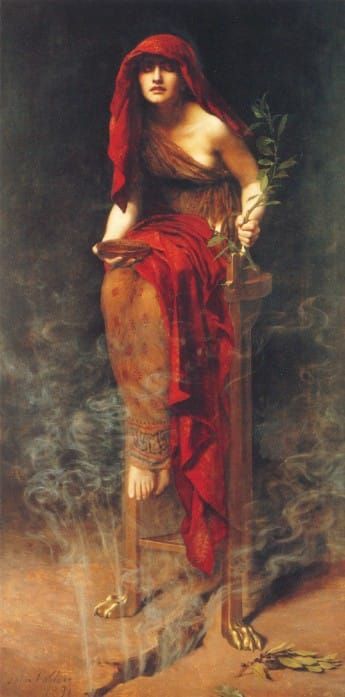
How a working priest at Delphi documented the oracle's decline in real time, and modern geology proved he was right
Around 95 CE, a Greek philosopher named Plutarch (yes, that Plutarch) was appointed as one of two sanctuary priests at the Temple of Apollo in Delphi. He would hold the position for roughly the next quarter century, until his death sometime after 119 CE. During that time he witnessed dozens, possibly hundreds, of prophetic sessions. He wrote three separate essays about Delphi and its oracle. He documented what happened in the temple's inner chamber with the methodical attention of a man who took his job seriously.
In his essays he described a sweet-smelling vapor that rose from a fissure in the floor. He described the trance state it produced in the priestess who inhaled it. He described the protocols the priests used to manage the process. And he described, with visible concern, the fact that the oracle's power was fading during his own lifetime.
For nineteen centuries, Western scholarship treated these descriptions as mythology. A priest talking about mystical vapors to them was obviously superstitious, but they were obviously wrong.
In 2001, a geologist named Jelle de Boer, an archaeologist named John Hale, and a geochemist named Jeffrey Chanton published a paper in the journal Geology (vol. 29, no. 8) that proved Plutarch was right about almost everything.
Two Faults Walk Into a Temple
What de Boer's team found beneath the ruins of Apollo's temple was not subtle. Two major geological fault systems intersect directly beneath the spot where the temple's inner sanctum once stood. The east-west Delphi fault zone and a north-south set of fractures called the Kerna fault cross each other at a point that corresponds to the location of the adyton, Greek for "inaccessible." It was the room where the Pythia sat and prophesied. She was the priestess who served as the oracle. Nobody else was allowed in.
The fault intersection matters because fault zones are pathways. Groundwater moves through fracture systems in bedrock. When that bedrock happens to be bituminous limestone, limestone rich in organic hydrocarbons, the water picks up dissolved gases along the way. De Boer's team sampled spring water near the temple and found methane, ethane, and traces of ethylene, all originating from the hydrocarbon-rich limestone in the deeper strata. They also identified travertine deposits on the temple walls, mineral residue left by spring water that once flowed through the site.
The geological infrastructure for gas emissions at the oracle was real, confirmed, and published in a peer-reviewed journal.
Then came the argument.
De Boer proposed ethylene as the gas responsible for the Pythia's altered states. Ethylene is sweet-smelling (which matches Plutarch's description of the vapor), mildly psychoactive in low doses, and was actually used as a surgical anesthetic in the early twentieth century. More on that in a moment.
In 2006, geoscientist Giuseppe Etiope and colleagues published a counter-study arguing that the geological conditions at Delphi couldn't produce ethylene in sufficient concentrations to induce a trance. They proposed instead that CO₂ and methane accumulating in the enclosed adyton would have depleted the oxygen, and the resulting hypoxia, not drug-induced euphoria, was what altered the Pythia's consciousness.
The debate continues. But here's the part both sides agree on, and it's the part that actually matters: the geology at this site produced real, measurable chemical conditions that induced altered states in the human being positioned above the fault intersection. Whether the mechanism was ethylene narcosis or oxygen depletion, the phenomenon was geological. The Pythia's "divine inspiration" was her nervous system responding to the earth's chemistry.
The ancient Greeks didn't build the most important oracle in the Mediterranean at a random location. They built it on the one spot where the geology reached the surface in a way that changed how a human brain worked.
And Plutarch told us this. In the first century. We just didn't believe him.
What the Gas Did to Her Body
This is where it gets genuinely unsettling, because we don't have to guess.
In 1923, a physician named Isabella Herb at Presbyterian Hospital in Chicago became the first person to administer ethylene-oxygen as a surgical anesthetic. She used it on over two thousand patients. Her clinical observations, published that year in Anesthesia & Analgesia, documented a clean, dose-dependent spectrum of effects.
At concentrations below 20 percent: patients entered a trance state. They could sit upright. They could hear questions and answer them coherently. But their voice changed. Their speech patterns altered. They lost sensation in their hands and feet. You could stick a pin in their skin and they wouldn't react. And when they were removed from the gas, they remembered nothing.
Above 20 percent: patients lost control of their limbs. They thrashed. They groaned in voices that didn't sound like their own. They staggered and fell.
In 2002, toxicologist Henry Spiller joined de Boer and Hale to publish a clinical analysis in the Journal of Toxicology: Clinical Toxicology. Spiller directed the Kentucky Regional Poison Center and had spent years researching the pharmacology of inhaled hydrocarbons. He mapped the documented effects of ethylene exposure directly against the ancient descriptions of the Pythia's behavior.
The match was close. Euphoria. Dissociation. Altered speech. Physical detachment. Rapidly shifting moods. Loss of inhibition. All without dulling consciousness. And ethylene smells sweet. Exactly as Plutarch described the vapors in the adyton.
Now go back and read what Plutarch actually recorded, because he described both ends of Herb's dose-response curve two thousand years before she documented it.
In the normal mode, the one Plutarch witnessed dozens of times, the Pythia entered a calm, seated trance. She remained on her tripod. She responded to questions in a voice that was recognizably altered. And afterward, Plutarch wrote, she was relaxed and composed. Tired but intact.
But Plutarch also described a second mode. A bad one. In this version, the Pythia thrashed wildly, screamed, lost control of her body, and collapsed. He recorded at least one specific case where a Pythia was forced to prophesy on an unfavorable day. The preliminary animal sacrifice had gone wrong. The goat didn't tremble when sprinkled with cold water, which was the standard omen-check before a session. The Pythia refused to enter the adyton. The priests insisted. An important diplomatic delegation was waiting.
She went in. According to Plutarch's account, the Pythia became hysterical, let out a terrible scream, ran for the exit, and threw herself to the ground. She died days later.
What Plutarch is describing, in terms a modern anesthesiologist would immediately recognize, is the difference between a controlled therapeutic dose and an uncontrolled overdose.
The Building Was a Drug Delivery System
The gas, on its own, couldn't have done what the ancient accounts describe. Not in the open air. Delphi sits on a mountainside. Wind blows through the Phaedriades, the massive cliff faces above the sanctuary, constantly. Any gas seeping through fault-line crevices would disperse in seconds. You can't get a useful concentration of anything in a well-ventilated outdoor space.
The adyton solved this problem. It was a sealed chamber beneath the temple floor, positioned directly above the fault intersection. The architecture concentrated what the geology produced. Without the enclosure, the gas was nothing. With it, the gas became a tool. The building wasn't decorative. It was the delivery mechanism.
And the priests managed the dose.
Consultations were restricted to the seventh day of each month (Apollo's birthday in the Greek calendar) and only during the nine warmest months of the year. The three winter months were off-limits; Apollo was said to be visiting the Hyperboreans in the north. De Boer noted that gas emissions at Delphi may have diminished during colder periods, which means the mythological explanation and the geological explanation point in the same direction.
Before each session, the priests performed a test. A goat was brought to the temple and sprinkled with cold water. If the goat trembled, the omen was favorable. If it didn't react, the session was cancelled. This looks, from a modern vantage point, suspiciously like a crude gas-detection method. If the animal was physiologically affected by trace gas concentrations near the temple, it would react to stimuli abnormally. If the gas wasn't flowing that day, the goat would just stand there, wet and annoyed. No prophecy.
The Pythia fasted before sessions. She bathed in the Castalian Spring. She chewed laurel leaves. She descended into the adyton alone, mounted a tripod positioned over the fissure, and breathed what the earth produced. The priests received her utterances from outside or behind a screen. They shaped the responses into the oracular pronouncements delivered to the consultants who'd traveled, in some cases, hundreds of miles.
This was not wild-eyed mysticism. This was operational protocol for managing a geological drug delivery system. Scheduled exposure windows. Pre-session safety checks. Recovery periods between sessions. At its peak, Delphi ran up to three Pythias in rotation, not because they needed more prophecy, but because the job was physically destructive enough that no single woman could sustain it.
Were the Prophecies Actually Right?
This is the question everyone asks, and the honest answer is more interesting than either "yes" or "no."
The most famous case is Croesus, King of Lydia, around 547 BCE. Before asking Delphi about his war plans, Croesus first tested the oracle's accuracy. He sent messengers to several oracles across the Greek world, each carrying the same question: what is the king doing on a specific day, one hundred days from now? Only Delphi answered correctly. According to Herodotus, the Pythia declared that a smell had come to her senses of a tortoise being boiled with lamb's flesh in a bronze pot. Croesus, hundreds of miles away, had been doing exactly that.
Satisfied, Croesus asked the big question: should he attack Persia? The Pythia's response: if Croesus crosses the Halys River, he will destroy a great empire. He attacked. He was crushed. His own empire was destroyed. The oracle had been technically and devastatingly correct.
Then there's the wooden-walls prophecy before the Persian invasion of 480 BCE. The oracle told Athens that only a wall of wood would save them. Most Athenians interpreted this as the wooden palisade around the Acropolis. Themistocles argued it meant the fleet, the wooden ships. He won the argument. Athens evacuated. The fleet destroyed the Persian navy at Salamis. The people who'd stayed behind the palisade on the Acropolis were killed by the Persians.
The temptation is to call these stories evidence that the oracle "worked," or to dismiss them as retroactive myth-making. I think both miss the point.
What I find fascinating is that the Pythia, in an altered neurological state, produced utterances that were fragmented, imagistic, and dissociative. The priests shaped these into responses that were consistently, deliberately ambiguous. And that ambiguity forced the consultants to think. Croesus failed because he only considered one interpretation. Themistocles succeeded because he was better at reading between the lines.
The oracle was, functionally, an ancient decision-support system. Geological chemistry produced a genuinely altered state. The altered state produced genuinely unusual cognition. Priestly protocols shaped that cognition into a deliverable format. And the ambiguity compelled the people who received it to consider multiple scenarios before committing to action. Every component, geology, chemistry, neurology, architecture, institutional protocol, interpretive framework, was doing real work. Remove any single piece and the system fails.
Which is exactly what happened.
Why It Stopped
Plutarch didn't just witness the oracle's operation. He witnessed its decline. In De Defectu Oraculorum (On the Obsolescence of Oracles), he grappled with a problem that troubled him as both priest and philosopher: the oracle was weaker than it used to be. There had once been two Pythias in active rotation with a third on reserve, but in Plutarch's time, one was sufficient. The pneuma seemed less potent. The prophetic states were harder to achieve.
Plutarch offered a diplomatic explanation: the population was smaller, so fewer oracles were needed. But his detailed descriptions of the declining vapor suggest he suspected something more mechanical.
The modern geological explanation fills in what Plutarch couldn't measure. Seismic activity shifts fault systems over centuries. Fractures open and close. New pathways form while old ones seal. The specific configuration of faults beneath the Temple of Apollo that allowed gas to reach the surface in useful concentrations was a geological window. Maybe a few thousand years during which the plumbing worked.
It's my opinion that the oracle's rise and fall tracks the geology, not the culture. It didn't decline because Greece became Christian. It didn't stop because people got smarter or more skeptical. It stopped because the earth moved, the fault pathways changed, and the gas supply that had sustained the phenomenon for a millennium gradually choked off. The final recorded prophecy was delivered around 393 CE, when the Emperor Theodosius ordered pagan temples to close. But the oracle had been weakening for centuries before the Christians shut it down. Theodosius didn't kill Delphi. The geology was already dying on its own.
The fault intersection is still there. The limestone is still bituminous. De Boer's team found trace ethylene in the Kerna spring water as recently as 2001. The geological conditions that produced the oracle haven't vanished. What's gone is the sealed room, the managed protocols, the woman positioned at the convergence point. The human technology that interfaced with the geological phenomenon and turned it into something usable.
The delivery system is dismantled. The gas is still seeping through the cracks.
And nobody is sitting above it anymore.
Sources and further reading:
De Boer, J.Z., Hale, J.R., and Chanton, J. "New evidence for the geological origins of the ancient Delphic oracle (Greece)." Geology, vol. 29, no. 8 (2001): 707–710.
Spiller, H.A., Hale, J.R., and de Boer, J.Z. "The Delphic Oracle: A Multidisciplinary Defense of the Gaseous Vent Theory." Journal of Toxicology: Clinical Toxicology, vol. 40, no. 2 (2002).
Etiope, G., Papatheodorou, G., Christodoulou, D., et al. "The geological links of the ancient Delphic Oracle (Greece): A reappraisal of natural gas occurrence and origin." Geology, vol. 34 (2006).
Herb, Isabella C. "Ethylene: Notes Taken from the Clinical Records." Anesthesia & Analgesia, vol. 2, no. 6 (December 1923): 230–232.
Plutarch. De Defectu Oraculorum and De Pythiae Oraculis. In Moralia, Volume V. Loeb Classical Library.
Herodotus. The Histories, Book I.
Connelly, Joan Breton. Portrait of a Priestess: Women and Ritual in Ancient Greece. Princeton University Press, 2007.
John Collier, Priestess of Delphi (1891). Oil on canvas. Art Gallery of South Australia. Public domain.
This is part of an ongoing investigation into the geology beneath the world's oldest sacred sites, what those sites were actually built to do, and what happens when nobody maintains them anymore. Delphi is one of sixteen sites explored in The Places That Speak, a novel that follows an archaeologist pulling on the same thread across four continents. The science is always free. Sign up to know when new pieces drop and get access to The Map.