
Before the Journal
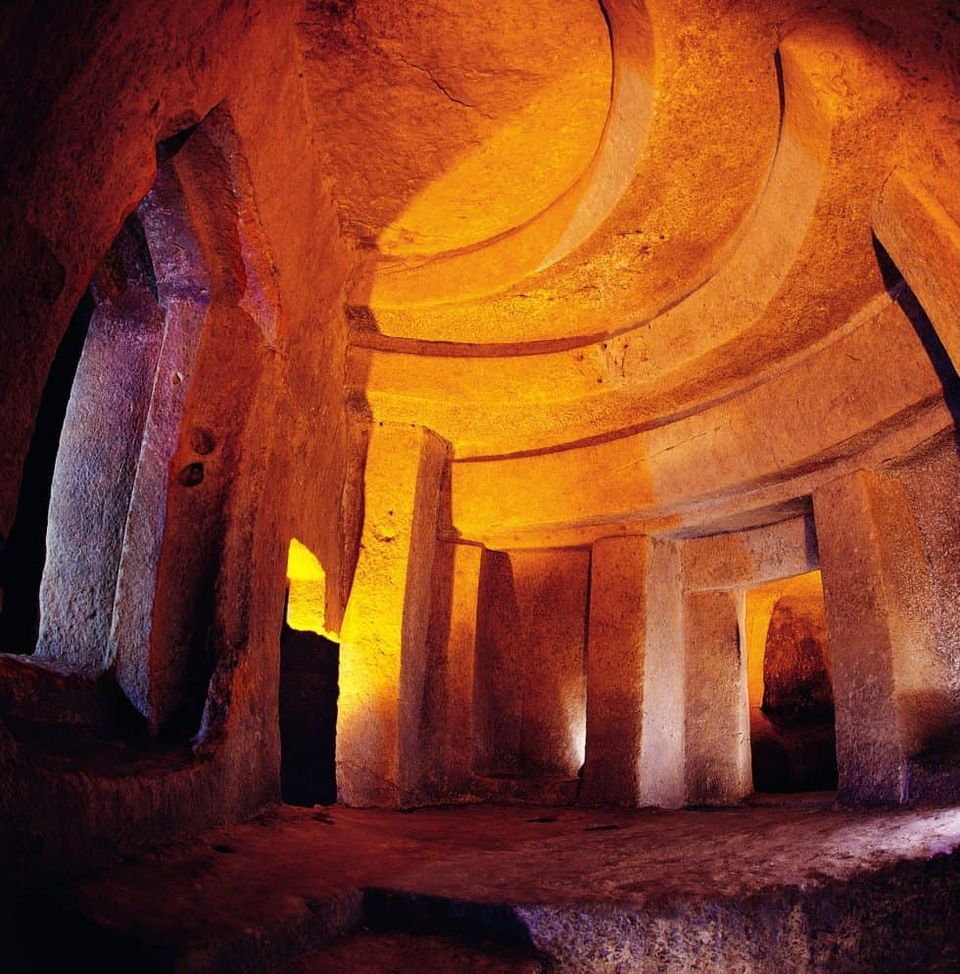
The air changed at the first threshold. Thicker, cooler — a different specific gravity. It tasted of mineral and time, a faint chalk at the back of the throat that I would later recognize at other sites, in other countries, always with the same quality: the taste of stone that has been breathing for millennia.
Five in the morning. The Hypogeum of Ħal Saflieni — the oldest known subterranean temple in the world, carved from living limestone between 3600 and 2500 BCE, the burial place of seven thousand dead. Dr. Farrugia and I had three hours before the public opening. She brought acoustic measurement equipment worth more than my car. I brought a department-store magnetometer, a voice recorder, and the kind of optimism that only survives in people who can't afford better gear.
I had been awake for thirty-one hours. I am recording this as a variable, not an excuse. Cortisol levels, blood glucose, attentional capacity — all degraded. The experienced fieldworker accounts for his own condition before accounting for his data. The honest fieldworker admits he was running on airport coffee and stubbornness.
The Oracle Room was on the middle level — a small chamber with a carved niche in the wall that functions, architecturally, as a mouth. The Neolithic builders shaped it to amplify low-frequency sound the way a cathedral amplifies a choir. This is the oldest known dream incubation site in the world: people came here to sleep among the dead and receive visions, and the room's acoustics were part of the technology. Farrugia's published measurements confirmed a resonance window between 70 and 130 Hz — frequencies felt in the body rather than heard by the ears. I spoke into the niche, keeping my register low, and felt the room answer — through the stone floor, through my boots, into my feet and sternum and the back of my skull. Not sound. Deeper than sound. The resonance was in my bones before it was in my ears.
I had been mapping this. For months, in a one-bedroom flat in Camberwell, on a wall covered in photocopied geological surveys and pins and string — the visual vocabulary of a man who is either onto something or profoundly unwell. The acoustic properties of this chamber matched the pattern on that wall. Limestone substrate. Subterranean water. A specific frequency range that produces a standing wave felt in the body rather than heard by the ears. If my thesis was right — if the ancient traditions built at geologically specific locations because those locations produce something detectable — then the Hypogeum was the place to test it.
I wrote: resonance confirmed, full-body effect noted, within expected parameters. I wrote it with a steady hand. My thesis had just survived its first field test.
I was fine.
Then Farrugia went back to the upper level to adjust her equipment. She asked if I wanted to come.
"Give me twenty minutes," I said.
She looked at my face. "You look terrible, Navarro. Have you slept?"
"I intend to answer that question later, when the answer is less embarrassing."
She almost smiled. Her footsteps faded up the passage, and then it was just me and six thousand years of dark.
I sat down against the wall. Just for a moment. The stone was cold against my jacket in a way that felt personal, the way a hand on a shoulder feels personal. I looked up at the triple-spiral ceiling and thought about the hands that carved it and how long they had been still.
The silence became something else.
Became full.
Three things happened. I am going to describe them because I sure as hell can't explain them.
The first: a symbol carved in stone. Close — close enough to see individual tool marks. The light was not my headlamp. Warmer. The color of oil lamps. The stone was darker, damp. Not this room. The symbol's registers were Near Eastern — the grammar familiar — but I don't recognize the specific combination. I had time to examine it carefully, the way you look at things in that state, each detail enormous.
Then it was gone.
The second: a sound. Or not a sound — something that arrived through the stone rather than through the air. Directional, originating from below and slightly south. A phrase. Phonemes I could not parse into any language I knew. Not random — structured, with the cadence of a complete sentence, spoken by something that understood sentences. I do not know if I heard it or felt it or dreamed it. I know it had a direction. I know it came from below.
The third: I was in my mother's kitchen. The low ceiling, the tiles with the blue fish pattern, the Andalusian afternoon light through the window over the sink. She was there — not an apparition, simply there, the way she was in life, wiping her hands on the dishcloth she kept hooked over the oven handle. She was speaking to someone I could not see. Her hand was extended toward the floor, palm down, fingers spread. Not pointing. Covering. Laying a hand on something that needed steadying.
She looked up. She found me without surprise, as though she had been waiting for me to arrive and I was, characteristically, late.
Her expression said: you see it now. Finally.
And underneath her palm, through the kitchen tiles, through the bedrock, through twenty-six years of trying not to think about what she had said — the house is full, Marcos — I felt something answer her hand with pressure from below. Something that had been there long before the house. Long before Cádiz.
Something that had been waiting with the patience of geology.
I woke to Farrugia's footsteps. My headlamp had dimmed to save power. The notebook was in my lap, open, the pen in my hand. On the page I had written — in handwriting I recognized but did not remember producing — three lines.
A sketch of the symbol. A phonetic transcription of what I heard, eighteen syllables, stress patterns marked. The field linguist's reflex, operating without the field linguist's consent.
The third line was a single word: tiles.
My hands were shaking. I closed the notebook before Farrugia could see it, which required the kind of fine motor control that should not have been available to me in that moment but was, because the body is a pragmatist even when the mind is not.
"Ready to go down?" she said.
I stood up. I put the notebook in my jacket and tried to regain some composure. Luckily it was dark.
"Yes," I said, in the steadiest voice I could muster. "Let's go down."
The investigation continues in Chapter 1: Göbekli Tepe, Turkey — the oldest marked place on earth. Subscribe to The Journal to follow Marcus into the field.